


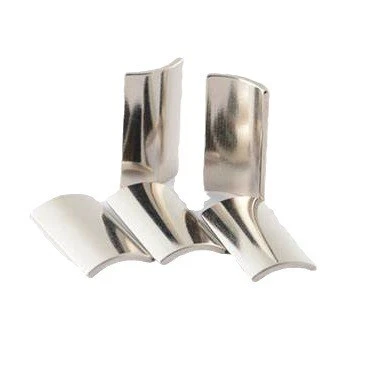


Short Product Description
We are a professional permanent magnet manufacturer with over 30 years of experience in rare earth magnet production. An arc segment neodymium magnet is a curved section of a ring magnet, defined by its outer radius, inner radius, arc angle, and thickness. Unlike a single-piece ring magnet, arc segments are assembled into a complete 360° magnetic ring, allowing engineers to construct large-diameter rotors and stators that would be impractical or fragile as monolithic rings. This modular approach also enables Halbach array configurations, where the magnetic orientation of each segment is rotated to concentrate flux on one side while cancelling it on the other. Available in grades N35 to N52, with temperature grades M/H/SH/UH/EH/AH. Custom arc angles, radii, and magnetization directions available upon request.
Technical Specifications
Parameter | Specification
Material | Sintered NdFeB (Neodymium-Iron-Boron)
Grade Range | N35 / N38 / N40 / N42 / N45 / N48 / N50 / N52
Temperature Grades | N (80°C) / M (100°C) / H (120°C) / SH (150°C) / UH (180°C) / EH (200°C) / AH (220°C)
Outer Radius | Custom, typically 10mm to 500mm
Inner Radius | Custom, to fit rotor or stator geometry
Arc Angle | 15° / 30° / 45° / 60° / 90° / 120° / custom
Thickness (Radial) | 3mm to 50mm standard; custom available
Length (Axial) | 5mm to 100mm standard; custom available
Tolerance | Dimensions >10mm: ±0.1mm; Dimensions ≤10mm: ±0.02mm
Magnetization Direction | Radial (poles on inner/outer arc), Axial (poles on flat faces), Circumferential (poles on ends)
Coating | Ni-Cu-Ni (standard), Zinc, Epoxy, Gold, Passivation, PTFE, Rubber
Max Energy Product (BHmax) | 263–422 kJ/m³ (N35–N52)
Density | 7.5 g/cm³
Product Features and Advantages
Modular Ring Construction – Arc segments allow engineers to build large-diameter magnetic rings that would be difficult or impossible to manufacture as single sintered pieces. Segments are precision-cut to form a perfect circle when assembled, enabling motor diameters far beyond the practical limits of monolithic ring magnets.
Halbach Array Capability – By rotating the magnetization orientation of each segment, arc magnets can be arranged into Halbach arrays that concentrate magnetic flux on one side of the ring while cancelling it on the opposite side. This significantly boosts efficiency in brushless DC motors and magnetic couplings.
Reduced Cogging Torque – Arc segments can be skewed or shaped to smooth out magnetic transitions between poles. This shaping directly reduces cogging torque, resulting in smoother rotation at low speeds and improved positional accuracy.
Three Magnetization Directions – Arc magnets are custom-magnetized to suit their application. Radial magnetization places poles on the inner and outer curved surfaces, the standard choice for motor rotors and stators. Axial magnetization places poles on the flat end faces. Circumferential magnetization places poles on the two ends of the arc. Specifying the correct direction is critical; our engineering team validates magnetization orientation against your rotor or stator geometry.
Material Selection Flexibility – Sintered NdFeB offers maximum magnetic strength for high-torque motors and generators. For applications where corrosion resistance, thermal stability, or cost are primary concerns, SmCo and ferrite arc segments are also available. SmCo operates effectively above 150°C and costs less than UH/EH/AH grades of NdFeB in some configurations.
Chamfered Edges for Assembly – All segments are processed with chamfered edges to prevent chipping during installation and glue-curing. This is critical because NdFeB is brittle, and edge damage during assembly can create fracture points that compromise the entire magnet.
Not a Ring Magnet – An arc segment is a single pole piece, not a complete ring. Eight arc segments assembled into a circle create eight poles. A multi-pole ring magnet has multiple poles magnetized into a single continuous ring. They serve different design purposes and are not interchangeable. Arc segments are preferred when the required ring diameter exceeds standard manufacturing limits, when the rotor must be assembled in situ, or when a Halbach array is required.
Application Scenarios
Traction and Servo Motors – Arc segment neodymium magnets are the fundamental building block of permanent magnet (PM) motors and servo motors. Multiple segments are assembled onto a rotor or within a stator to create a powerful, precise magnetic field. Their curved profile allows the magnet to conform closely to the stator bore, minimizing air gap and maximizing flux linkage.
Wind Turbine Generators – Direct-drive wind turbine generators use large-diameter arc segments to convert mechanical wind power into electricity efficiently. Segments allow the generator ring diameter to exceed 1 meter while maintaining assembly feasibility. SH and UH grades are recommended to withstand the temperature rise during continuous operation.
Magnetic Couplings – Large neodymium arc segments transmit mechanical torque without direct contact between drive and driven shafts. This reduces wear, eliminates leakage risk, and minimizes maintenance in pumps, chemical reactors, and sealed industrial systems.
Robotics and Automation – Automated motion systems use arc magnets to provide precise, smooth, and high-torque movement in robotic joints and intelligent machines. The ability to shape the pole transition reduces vibration and improves positional repeatability.
Aerospace Actuators – The aerospace industry utilizes lightweight, powerful arc magnets in motors, actuators, and control devices that demand precision, thermal stability, and high reliability under extreme conditions.
Elevators and Traction Systems – Arc magnets are used in elevator traction machines to ensure smooth operation, reduce vibration, and lower power consumption compared to traditional induction systems.
Quality Assurance and Certifications
Certifications include IATF 16949 (automotive quality management), ISO 9001, ISO 14001 (environmental), and ISO 45001 (occupational health). Compliance with RoHS, REACH, and CP65. Magnetic performance tested per IEC 60404-5 or ASTM A977, measuring Residual Flux Density (Br), Intrinsic Coercivity (Hcj), and Maximum Energy Product ((BH)max). Chemical composition verified via ICP-OES or XRF per GB/T 8762 to confirm Nd content and batch consistency. Dimensional inspection covers outer radius, inner radius, thickness, and arc angle. 100% inspection on all critical parameters. Full traceability from raw material to finished product. Packaging uses anti-magnetic shielding, foam protection, and export-grade cartons with wooden spacers for large assemblies.
Customization Services
We offer full customization on Arc Geometry – Outer radius, inner radius, arc angle (15° to 120°), thickness, and length tailored to your rotor or stator design. Grade – N35 to N52, with temperature grades M/H/SH/UH/EH/AH. Magnetization Direction – Radial, axial, or circumferential; custom skew angles available for cogging torque reduction. Coating – Ni-Cu-Ni, Zinc, Epoxy, Gold, Passivation, PTFE, or Rubber. Surface Treatment – Chamfered edges standard; countersinks and through-holes for mechanical mounting available. Material Alternatives – SmCo (Sm2Co17) for high-temperature and corrosion-sensitive applications; ferrite for cost-sensitive large motors.
Critical Design Note: Radial magnetization of anisotropic sintered NdFeB arcs is technically difficult because the magnetization direction of anisotropic magnets is predetermined during pressing. The most cost-efficient approach is to diametrically magnetize the magnet blank and then machine the arc profile. For applications that absolutely require true radial orientation, ring magnets should be considered as an alternative. Our engineering team can advise on the optimal magnetization strategy for your specific motor topology.
Sample Policy: Custom samples available within 10–15 working days. Free samples for qualified motor and generator development projects.
Why Choose Us
We have over 30 years of experience in rare earth magnet production. Our engineering team understands the practical trade-offs between arc segment and ring magnet designs, and can recommend the correct geometry based on your motor diameter, assembly constraints, and target performance. We offer chamfered-edge processing as standard to prevent chipping during assembly, and can produce skewed segments for cogging torque reduction. We provide both NdFeB and SmCo material options, allowing you to balance magnetic strength, temperature resistance, and cost. Long-term supplier to Fortune 500 companies including General Motors, Ford, Samsung, and Xiaomi. 24-hour quote and technical support.
Frequently Asked Questions
What is the difference between an arc segment magnet and a ring magnet? An arc segment is a single curved pole piece; multiple segments are assembled into a ring. A ring magnet is a single continuous piece with one or more poles magnetized into it. Arc segments are preferred for large-diameter rotors, Halbach arrays, and applications where a monolithic ring would be too fragile or expensive to manufacture.
How do I choose between radial, axial, and circumferential magnetization? Radial (poles on inner/outer arc) is standard for motor rotors and stators where flux must cross the air gap. Axial (poles on flat faces) is used for axial-flux machines and thin rotor discs. Circumferential (poles on ends) is used for specific sensor and coupling applications. The choice depends on your magnetic circuit design.
Can I build a Halbach array with your arc segments? Yes. We manufacture arc segments with customized magnetization orientation per segment, enabling Halbach array configurations that concentrate flux on one side and cancel it on the other. This is commonly used in high-efficiency BLDC motors and magnetic couplings.
What grade should I choose for a wind turbine generator? SH (150°C) or UH (180°C) grades are recommended for wind turbine generators due to the heat generated during continuous operation. Standard N grade (80°C) is typically insufficient for this application.
Can arc segments be skewed to reduce cogging torque? Yes. We can manufacture skewed arc segments where the pole transition is angled relative to the axis. This smooths the magnetic transition and reduces cogging torque, resulting in smoother low-speed rotation and improved positional accuracy.
What is the delivery time? Standard arc segments: 15–20 working days. Custom geometries with new tooling: 25–35 working days. Sample orders: 10–15 working days.
What is the minimum order quantity? MOQ varies by size, grade, and arc angle. Contact us for details.
Is SmCo available as an alternative to NdFeB? Yes. SmCo arc segments are available for applications requiring operating temperatures above 150°C or superior corrosion resistance without coating. SmCo can be more cost-effective than UH/EH/AH grades of NdFeB in some high-temperature configurations.
Contact Us
Get a Quote Today! Email: zb16@magnets-world.com. Phone/WhatsApp: +86 18119636123. Address: Room 201, No.15, Longxinli, Siming District, Xiamen, Fujian, China. We reply within 24 hours.
Hot Tags: arc segment neodymium magnets, China arc segment neodymium magnets manufacturers, suppliers, factory